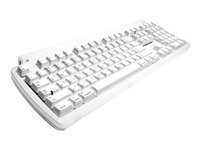
 Buy The Matias Tactile Pro Keyboard
The Matias Tactile Pro Keyboard Product Description:
- Low profile for easy storage inside a keyboard drawer
- Ice white finish
Product Description
The best keyboard Apple ever made rises again. The Matias Tactile Pro Keyboard is built from the same premium keyswitch technology that Apple used in its original Apple Extended Keyboard, widely viewed as the best keyboard Apple ever made.
Customer Reviews
Most helpful customer reviews
60 of 60 people found the following review helpful.
 TactilePro Version 3 Keyboard Review
By Lawrence Hare
I am impressed enough by this keyboard to write a brief review, but first and foremost, this is a keyboard for those who type a lot, or who type professionally, and it is not cheap. But you get what you pay for and in my opinion, this is very good value for money.For a decade or so I have used an Avant Stellar which I absolutely love, like the TactilePro is has the Alps key-switches, and the version of the switch that gives both audible and tactile feed-back - it is noisy. The keys on the TactilePro, like the Avant, have full travel and have just enough push-back to be convincing yet not tiring. The Avant is a heavy duty keyboard, no squeaks or rattles and it is VERY well made. The trouble with my Avant is that it is BIG as it has an extra set of function keys down the left side, and it loses its marbles about once a day; it will suddenly send oddball characters and I need to unplug it and replug it to clear it up. It needs a PS/2 to USB converter, it does not have the Mac keytops, it has PC, but it is fully programmable, so one can exchange key-codes and it works fine, but for years there was no other keyboard that came close in touch and feel, so I continued to use it.I have been eyeing the TactilePro for a year or two but the trouble was it got mediocre reviews. Then out came version 3 and it seemed all the complaints had been addressed, so I bought one, and it is all I had hoped for. The TactilePro has n-key rollover so you can type as fast as maybe and not lose any characters, a problem with many lesser keyboards. It is solid enough that typing feels secure, certainly as good as the Avant. It is a USB hub with three ports and I really like the fact that all Option and Shift-Option characters are imprinted on the top right of each key. The shift light is on the Caps-Lock key, a far better place than up in the top right hand corner of the keyboard, it has volume controls which is useful, and it has no frills other than that! It is a keyboard, a Mac keyboard, not a cheap one, but a very, very good one.If you type a lot, professionally, all day, and you are a good typist, this is a must-have in my opinion. I shall be buying another one for home, and dump that utterly terrible skinny aluminum keyboard my iMac came with. I can type faster and easier on the TactilePro - by far - than on the skinny aluminum thing. Apple used to have the very best keyboards, I find the new batch of skinny things to hurt and be hard to type on, the TactilePro is an essential part of my desktop. Recommended.
31 of 31 people found the following review helpful.
"What the heck is that?"
By Eric Geilker
For those of you who started using keyboards in the last fifteen years, that's what you will say when you hear someone typing away on the Matias Tactile Pro 3 Keyboard. At least, that's what my 17 year old son immediately said when he walked past my desk on the first day I tried out this amazingly retro new keyboard for Macs: "What the heck is that?" You can't miss the sound--click, clack, click. So then, I beckoned for him to sit down, open Word, and try it himself. He sat down, started typing full speed, and his face lit up, he started laughing! Okay, was he laughing AT me for buying such a crazy keyboard, or was he laughing from sheer joy of the almost steam punk mechanical sound and feel of the keyboard? Probably a little bit of both. But for me, a guy who bought his first Apple computer in 1985, I feel I have come home. I love this keyboard and the era it evokes. Maybe I should quit my job as a real estate investor and take up writing pulp fiction full time just to enjoy the sensation this keyboard affords. On the other hand, maybe I should just write long-winded reviews on amazon.com. Either way, this keyboard is fantastic. Maybe not in a crowded office, maybe not in the echoic marble reception area of a funeral home, but for a 47 year old dude in the privacy of his own home, it's MUSIC.Objectively, the keyboard layout is IDENTICAL to the keyboard that came with my 2003 iMac (keyboard model M7803). It is the same size, exact same number of keys, same color, etc. No, as previous reviewers have noted, it does not have markings for expose, but then again the Mac keyboard which it emulates does not have these marking either. Installation was simple, perfectly compatible w/ OS 10.5.8 that I am running.But the keyboard has a fantastically welcome feature I wasn't expecting: a long cord! No, it's not wireless, it's better...it has a long cord. The Mac keyboard whose layout it emulates has a cord length of 33 inches, but the Matias Tactile has a cord length more than twice as long at 72 inches. For someone who leans back and chills in front of the screen keyboard in lap, this extra length is very freeing, comfortable.In conclusion, if you are a typical 25 year old, forget it. Stay away from this keyboard because you are too young and too boring. But if you have click-clacked away on a late 80's vintage PC, or if you learned to type on a mechanical or electric typewriter, you are in for a treat with the Matias Tactile Pro.
32 of 34 people found the following review helpful.
 Good but room for improvement. . .
By Theseus
Given that many people are not familiar with this style of keyboard, I'm going to break this review down into two sections, first about the style of keyboard that this is, with plusses and minuses, and secondly about this particular product from Matias.The keyboard style:Like many others, I too missed the clickity-clack of older buckle-spring key switches. I learned to type on a variety of devices ranging from electric and electronic keyboards to computer keyboards including the classic IBM Model M. This keyboard is very close to that one and, supposedly, is very similar to an old Apple keyboard, the Apple Extended Keyboard, which I never had an opportunity to try.The reason this is called a "Tactile" keyboard is that there is a significant amount of fingertip feedback generated by the individual keys. Modern keyboards tend to forgo individual mechanical switches in favor of membrane-style sensors that are similar to pressing on little sponges. It's both cheaper and quieter, but is not very finger friendly. Additionally, the keys on new keyboards tend to be fairly flat, such that your fingers may be pressing the edge of a key rather than the center and your hands can start to get out of alignment a little more easily.Keyboards like the Tactile Pro have much more key travel and sensory feedback than the newer keyboards. Your fingers seem to bounce along as you type rather than hammering a flat surface. As a result, your hands don't move as much as the keys absorb the impact of your fingers much better. Additionally, you tend to get a better sense of your typing speed and, typically, find yourself typing much faster and smoother with fewer errors (though this is debatable) as you go along. As someone else said, this is a great keyboard for people who are high-speed touch typists or who work in a field where lots of text output is part of the job (journalist, writer, blogger, etc.).There will definitely be downsides for some people, though. First, of course, is the noise. This keyboard is great if you're in a room by yourself and are generating a lot of text. However, if you're in a coffee shop, or a classroom, or have a roommate/spouse/etc. in the immediate area, the constant clickity-clack can become annoying to them. I suspect this is the main reason, along with cost, that these sorts of keyboards have fallen out of style. Don't get me wrong, they're not particularly loud, but the constant, repetitive noise can get bothersome, especially if your environment is intended to be quiet (e.g., a library). Of course, this is a big keyboard, so you're not likely to be toting it around with you outside of your home/office anyway, but take this into consideration. For comparison's sake, I would say that this is significantly quieter than an old manual typewriter and somewhat quieter than an electronic typewriter as well. In fact, each click is much quieter than your average ball point pen click. But there will be a lot of them, and if you're cruising along at 100 wpm, that adds up.Also, as mentioned, this is a full-sized keyboard with number pad. It's not heavy, but it is not stylishly thin and smooth like an Apple keyboard is. These things aren't really meant for portability and are ideally suited to a desktop environment. If you put this in your bag, you're going to hear the keys clicking away as your bag rocks back and forth. This can get old pretty quickly. You'll also notice that there's a little "play" in the keytops. You can rest your fingertips on the surface of the keys and slightly wiggle them back and forth. This is normal for this style of keyboard and shouldn't be taken as a defect. It's simply a product of the longer-than-usual key travel that these keys have and actually seem to serve a purpose as a sort of automatic adjustment to your fingertip angles. For some people used to the membrane-style keyboards, though, this could be disconcerting at first.Therefore, for anyone who does a lot of typing, you should really consider getting one of the buckle-spring keyboards for your machine. Currently, this one and one other (I'll mention in a moment) exist, to my knowledge.This specific Matias keyboard:I think I've soured a little bit on Matias products. This is the third different keyboard I've purchased from them, the other two being folding portables, and they all have problems. I'll start, though, with the positives.The buckle-spring mechanism on the keys is classic and exactly as I recall the old IBM Model M keyboards behaving. Of course, that was 20 years ago, so I could be off by a little, but regardless, this keyboard is very nice to type on. It's making me wonder why I didn't do the switch years ago. The angle at which the keyboard sits (adjustable slightly with the built in feet), is also conducive to rapid typing with the wrists up off the table in proper, just-like-I-was-taught-in-school position. That should help with repetitive motion injuries some as well. Also, something I haven't had before is a USB port on the keyboard itself. Two of them, in fact. I think this will come in handy for things like USB thumb drives and whatnot given that the iMac USB ports are way around back and hard to reach. I like the idea, in concept, and I'm sure I'll make use of it a lot.Now, for the downsides.The whole keyboard feels cheap. The old Model M keyboards to which I am comparing this to were built like tanks. You got the sense that they could take a .45 round in the back and still keep typing away. They were also heavy, much heavier than this keyboard, which also gave you a sense of durability. This, on the other hand, is very plasticky. The keys themselves are fine, but the surrounding material makes the whole keyboard feel like a $20 keyboard rather than one well over $100.I've also noticed that at least one key, the number pad's "0" key, is much harder to press than all the other keys on the keyboard, including the space bar. When your fingers get accustomed to pressing only so hard to type a key and then have to press twice as hard to belt out a zero, something's wrong. I haven't "tested" every other key on the keyboard, but so far, that's the only one with a problem out of 90+ keys I have used.Lastly, as mentioned by another reviewer, the function keys are labelled only with the F1-F15 numbers. No idea what they do otherwise. There's no marks for Expose or any of the other default Mac shortcuts. I'm not even exactly sure how to make them do their alternate function as there is no function key on the keyboard. The manual that came with the keyboard is endearingly short (basically, "to install keyboard, plug it in" and that's it), but not very helpful in this regard. Thankfully, the volume controls and eject key ARE labelled and sit just over the number pad. That's the main thing you need, and you can easily switch your keymappings in OS X to be whatever you want, but it would be nice for them to label these keys as well if they're going to go so far as to label the copyright and trademark symbols on the other keys.Oh, and about that installation thing. OS X doesn't recognize this as a Mac keyboard per se. In fact, it asks that you press a couple of keys on the keyboard and identify the layout of the shift-return-backslash keys on the right. This is common with third party keyboards, but I've had several keyboards just be recognized automatically by OS X and was surprised when this one wasn't. Not a deal breaker, just strange.Overall, this is the best typing experience I've had on a Mac since I became a convert. This also beats all the PC keyboards I've tried back to the older IBM keyboards about 20 years ago. That alone earned it 4 stars. I had to deduct some for the cheapness of the experience, however, and the faulty 0 key on the numberpad. I may call customer service and see what they can do about that.Oh, and by the way, the other buckle-spring keyboard I know of available for purchase is the "Das Keyboard." It's a PC keyboard but can be had with key swap-outs for Mac keys (or Linux) so you can replace the Windows keys with Mac keys. It looks to be better built than this for about the same money, and I may have to try it, now that I've fallen back in love with the buckle-spring. We'll see. I do believe there are some smaller manufacturers out there as well who either make or convert these style keyboards, but I don't have any names for you.
See all 46 customer reviews...Latest Price:
See on Amazon.com!
More Info:
See on Amazon.com!
See Customers Review:
See on Amazon.com!

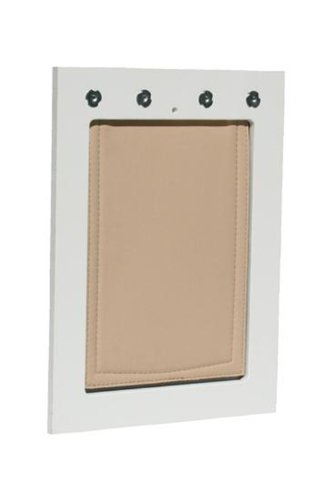 Buy Energy Efficient Dog Flap for Wall without Locking Security Panel - Large Dog Flap Installs Into Exterior Wall
 Very energy efficient but also very loud